
NEW YORK — Five decades after K walked through the orange-hued ash of Las Vegas and four decades after Rick Deckard chased nexus models through the rain-drenched neon of 2019 Los Angeles, the Blade Runner saga is confronting its ultimate existential question.
During Saturday’s flagship panel at New York Comic Con 2026, Prime Video unveiled the first full-length trailer for Blade Runner 2099, an ambitious eight-episode limited series premiering November 25, 2026. Executive produced by original franchise auteur Ridley Scott and created by showrunner Silka Luisa (Shining Girls), the new series flips the central power dynamic of sci-fi’s most celebrated dystopian world upside down.
A World Where the Replicants Won
Set a half-century after the events of Denis Villeneuve’s 2017 feature Blade Runner 2049, the world of 2099 is no longer governed by humanity. The long-simmering Replicant uprising has occurred, and mankind has lost its dominance. Los Angeles has been reborn under new rule, leaving remnants of humanity struggling to find purpose in a society where synthetic life forms reign.
“The original films looked at mortality on a micro level—Roy Batty and K were fighting for more life,” showrunner Silka Luisa explained during the NYCC panel. “This series asks that same question on a macro level. What happens when our time as a species ends? Can we hold on to our humanity when everything is slipping away?”
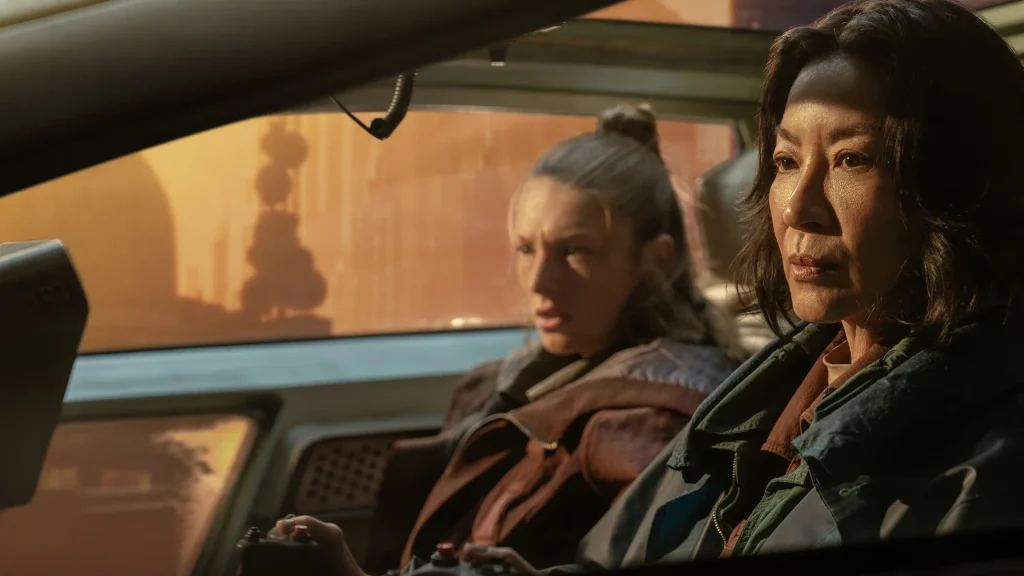
An Unlikely Detective Duo
At the core of the series is a neo-noir investigation starring Oscar winner Michelle Yeoh and Hunter Schafer (Euphoria):
- Olwen (Michelle Yeoh): A veteran Replicant Blade Runner down to the final days of her pre-programmed lifespan, racing against time on one last high-stakes case.
- Cora (Hunter Schafer): A human fugitive who, in a desperate bid to survive, assumes a new identity by disguising herself as a Replicant Blade Runner—a stark reversal of the franchise’s historical precedent.
Forced into an uneasy partnership reminiscent of classic Chinatown-style noir, the pair is dispatched to investigate the disappearance of 38 missing Replicants and track down a fugitive who holds a secret capable of destroying the city’s fragile ecosystem—along with rumors of a mysterious figure who “knows the cure for all Replicants.”
             BLADE RUNNER TIMELINE

   2019 (Blade Runner)   ──►  2049 (Blade Runner 2049)   ──►  2099 (Blade Runner 2099)
   • Human hunts Replicants   • Replicant hunts Replicants    • Human disguises as Replicant
   • Micro-level mortality    • Replicant miracle uprising     • Species-level extinction
“More Human Than Human” Revisited
Visually, the trailer showcases a distinct aesthetic evolution. Helmed in early episodes by director Jonathan van Tulleken (Shogun), the production relies heavily on 360-degree practical sets, tactile retro-futurism, and oppressive urban heat rather than traditional dark rain.
The trailer also introduces atmospheric details like red-light districts catering to synthetic beings searching for authentic human experiences, contrasting starkly with echoes of the Tyrell Corporation’s famous legacy. As one character grimly notes in the footage, “‘More Human Than Human’ isn’t a slogan—it’s a curse.”
With all eight episodes arriving at once on November 25, Blade Runner 2099 promises a complete narrative arc that tests whether humanity is defined by flesh and blood or the choices made when time finally runs out.
The Thematic Evolution Across the Blade Runner Trilogy
The transition from Blade Runner (1982) to Blade Runner 2049 (2017), and now to Blade Runner 2099, represents a philosophical escalation. Where previous entries questioned individual identity, 2099 scales these anxieties up to the survival of the human species itself.
1. The Human Paradigm: Hunted vs. Hunter
| Era / Film | Protagonist Dynamic | Core Existential Question | Scope |
| Blade Runner (2019) | Human (Deckard) hunts synthetic Replicants | “What makes a soul human?” | Individual Mortality: Roy Batty fighting for more time before his four-year lifespan expires. |
| Blade Runner 2049 | Replicant (K) hunts older-model Replicants | “Does an artificial life have a purpose beyond its code?” | Societal Identity: The discovery of Replicant reproduction threatens the societal caste system. |
| Blade Runner 2099 | Human fugitive (Cora) disguises as Replicant; Replicant (Olwen) nears death | “What defines humanity when Replicants control the world?” | Species Extinction: Mankind is displaced as Replicants assume societal dominance. |
2. Inverse Identity and the Disguise Dynamic
In Ridley Scott’s original film, Replicants desperately sought to pass as human—using implanted memories and stolen photographs to ground their stolen humanity. Denis Villeneuve’s 2049 flipped this, putting a Replicant in the detective role who desperately wished his “recollected” memories made him the unique, born child of a miracle.
Blade Runner 2099 completes the cycle in reverse through Hunter Schafer’s character, Cora. A human fugitive fleeing persecution, Cora must disguise herself as a Replicant to survive in a city ruled by synthetic life forms. This shift mirrors real-world anxieties surrounding artificial intelligence and automation displacing human agency.
3. The “Cure” and the Curse of Expiry
A primary motif driving the 2099 narrative is Olwen’s (Michelle Yeoh) impending expiration.
- 2019: Roy Batty’s famous “Time to die” moment stemmed from an inescapable biological timer hardcoded by Tyrell.
- 2099: Olwen, in the final days of her pre-programmed lifespan, pursues rumors of a “cure”—a way to strip away the built-in expiry date.
This pursuit exposes a poignant paradox: in seeking biological immortality, Replicants are inheriting humanity’s most fundamental flaw—the instinctual, desperate terror of their own termination.